
The True Story: Jack the Railway Baboon: 1880s Uitenhage, Eastern Cape
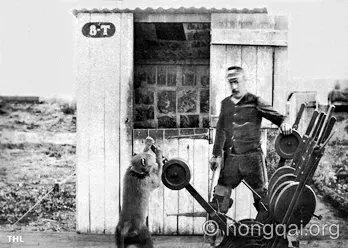
https://en.wikipedia.org | Signalman Jack
Abstract
Jack the Baboon was a famous Chacma baboon who worked as an official railway signalman at the Uitenhage station in the Eastern Cape during the 1880s. He was trained by his owner, James "Jumper" Wide, a paraplegic signalman, to operate railway levers and safely switch tracks for nine years without a single mistake.
Background
James Edwin Wide was born in Burlescombe, Devon, United Kingdom in 1850. He was the son of Thomas Wide and Mary Sweeting. He died in 1921 in the UK.
Later in life he moved to the Cape Colony in South Africa, were in 1870s he was employed by the Cape Government Railways guard/signalman in the station of Uitenhage in the Cape Colony. He had the nickname of " Jumper" for his skill at leaping between moving railcars.
Wide’s daredevil habit caught up with him. He miss-timed a jump between moving cars, fell under an 80-ton train, and had both legs crushed below the knees. He survived, but was left a double amputee. He made himself wooden peg-legs and a hand trolley to get around.
Desperate to keep his job, Wide fashioned makeshift wooden prosthetic legs and a small trolley to get around.
The railway felt sorry for him and agreed to keep him on as a signalman, but his employment status remained precarious. It was mostly levers from a chair, but the ½-mile commute from his cottage was still brutal in the trolley.
Enter Jack: 1881
One afternoon "Jumper" Wide was visiting the marketplace in Uitenhage where he saw a baboon leading an ox wagon. He met the owner who demonstrated how smart the primate was. Soon, Jumper was convinced the baboon could serve him well. He pleaded with the owner to let him have the baboon. The owner didn’t really want to give up his favorite pet, but he felt sorry for the crippled man.
Jack’s owner to give him the baboon, though he was warned that Jack would sulk all day unless given a “tot of good Cape brandy.” A consummate worker. Wide made him his personal assistant and soon Jack was helping Wide in his household chores, such as sweeping floors and taking out the trash.
He also turned out to be a very good watchman. Intruders were greeted by a fierce guard who gnashed his teeth and snarled ferociously to frighten away unwelcome visitors.
James also taught Jack to push him to work and back in a small wooden trolley and Jack soon learned how to transport Wide around on the man’s trolley. Jack even made work enjoyable, preferring to jump into the trolley with his owner during downhill sections.
As Jack observed the railway workers performing their duties, something extraordinary happened – Jack started to mimic their actions. His fascination with the railway’s operations led him eventually to learn the intricacies of signal work. He watched closely as the signalmen pulled levers, changed signals, and ensured the safe passage of trains. Remarkably, Jack began to imitate these actions, demonstrating an uncanny ability to understand the mechanisms at play.
Jack the "Signals man"
Jack eventually learned to perform Wide’s signalman duties. Wide would hold up one or two fingers and Jack would then pull the correct lever. He always looked at his master for confirmation. In the end, the baboon needed no instructions from his master. Jack really knew which lever to operate for each approaching train, based on signals, the whistle codes from incoming train drivers: one, two, or three blasts meant Jack should switch the lines accordingly, pulling points/levers himself while Wide sat in the cabin.
Four blasts signalled him to fetch the key to the coal shed for the driver. He knew the difference between the “home” and “distant” signals, and also the engine whistles; and although he was always under the eye of his master, he never made a mistake or required telling twice. Jack was one of the sights of Uitenhage for many years, and his astonishing feats of intelligence was the wonder of all who witnessed them. Jack caught the various offerings thrown to him by passengers from passing trains. Jack’s consistent and competent performance earned him the nickname ‘Jack the Signalman.’
The Partnership
Wide and Jack worked together for ∼9 years, 1881-1890. When passengers complained about a baboon on duty, railway officials tested Jack. He passed. He was put on the books: 20c/day + ½ bottle beer/week.
Wide called him “not merely his assistant, but also his best friend”.
Jack and James Wide (Public Domain)
Word Spreads
One day, a woman riding the train noticed a baboon changing the rail tracks as her train entered the station. Alarmed, she reported the incident to the railway company. Upon receiving the report, the company’s executives assumed the story was untrue. After some convincing, however, they sent a delegation to see exactly what was happening at the Uitenhage station. They arrived to find Jack the baboon hard at work.
Jack’s owner challenged the officials to test the baboon as rigorously as they wished. Jack passed every test, safely switching the rail tracks and checking both directions for confirmation. Shocked but satisfied, the railway company made Jack a bona fide employee, paying him 20 cents a day and half a bottle of beer each week. They even gave him an employment number. Jack the baboon truly became Jack the Signalman.
The Legend Endures
After several years of exemplary service—during which he never made a mistake—Jack died of tuberculosis in 1890. Although many people may find this story hard to believe, several primary sources attest to Jack’s abilities as a railway worker. A Cape Mercury newspaper article published on May 29, 1923, includes an interview with Wide and written statements from 25 witnesses. This story raises the question: What other kinds of jobs could baboons perform with the right training?
Wide was reportedly “inconsolable to the loss of his friend”, and the railway even gave Wide a lifetime pension afterward. After Jack's death Wide disappears from records after that.
Cape Mercury 05 April 1923 "Jack the Baboon"
The paper ran an investigation after Jack’s story started sounding like a legend. They collected "25 signed witness statements" from Uitenhage railway staff, passengers, and locals who worked with Jack 1881-1890.
What the 25 witnesses confirmed:
• Employment: Jack had his own employee number and was officially on the Cape Government Railways books. Pay: 20 cents/day + ½ bottle beer/week.
• The test: After complaints, railway officials set up a test. A train was sent in with the whistle code changed. Jack watched, hesitated, then refused to pull the wrong lever. He only worked when Wide gave the correct signal
• Zero mistakes: In 9 years at Uitenhage points, Jack never caused an accident. Staff swore to it under oath
• His duties: Pulled levers/points, pushed Wide’s trolley ½ mile to work, swept the station, took out rubbish, pumped water. He was chained outside the signal box while working
• Personality: Described as “extremely intelligent, gentle, and devoted to Wide” He’d salute officers and knew his name
• Aftermath: With those statements, the Cape Government Railways formally acknowledged Jack as a bona fide railway employee. His skull and service records are now in the "Albany Museum, Makhanda/Grahamstown"
Conclusion
Jack’s story lives on as a testament to the remarkable adaptability and intelligence of animals. His tale serves as a reminder that animals are not only capable of forming deep bonds with humans but can also surprise us with their abilities when given the chance.
The story of Jack the "Signalman Baboon" is more than just a historical curiosity; it’s a touching narrative of an unlikely friendship and the incredible feats that can be achieved through dedication and determination. Jack’s legacy continues to inspire us, reminding us of the profound connection that can exist between humans and the animal kingdom. In the end, Jack the baboon was not just a signalman; he was a symbol of the extraordinary potential within all living creatures.
References
https://en.wikipedia.org/wiki/Jack_(baboon)
https://baboonmatters.org.za/the-baboon-that-worked-for-the-railroad/
https://fielders.com/jack-the-baboon/